

Equal Protection Guarantees in Child Custody Determinations: The Equal Protection Clause of the Fourteenth Amendment prohibits family courts from rationing parenting time or awarding primary custody based on gender stereotypes, maternal preferences, or traditional marital roles (Palmore v. Sidoti). Both fit parents possess equal, fundamental constitutional standing to raise their children. State practices creating unequal custody awards violate constitutional mandates unless justified by a compelling state interest executed through least restrictive means.
Remember that many Ph.D.'s will refer to "shared parenting". Don't let them get away with that. Insist on equal parenting as the starting point.
Go to the post on equal parenting stats to support your argument that shared parenting must start with "equal!"

Download this document here Shared-Parenting-effects-on-Education
References from this document:
Holstein, N. (2015, May 21). Reining in our nation’s family courts.
Bergstrom, M. F. (2015, April 28). Fifty Moves a Year: Is There An Association Between Joint Physical Custody and Psychosomatic Problems in Children? Journal of Epidemiology and Community Health.
Bauserman, R.. (2002). Child adjustment in joint-custody versus sole-custody arrangements: A meta-analytic review. Journal of Family Psychology, 16, 91-102.
Maccoby, E. E., and R. H. Mnookin. 1992. Dividing the Child: Social and Legal Dilemmas of Custody. Cambridge, MA: Harvard University Press.
Melli, M., & Brown, P. (2008). Exploring a new family form: The shared time family. International Journal of Law, Policy and Family, 22, 231–269.
Lamb, M.E. & Kelly, J.B. (2009). Improving the quality of parent-child contact in separating families with infants and young children: Empirical research foundations, (pp. 187-214). In R.M. Galazter-Levy, J. Kraus, & J. Galatzer-Levy, The scientific basis of child custody decisions. Hoboken, NJ: Wiley.
Nord, C., Brimhall, D., & West, J. (1997). Fathers’ involvement in their children’s schools. National Center for Education Statistics, U.S. Department of Education, Washington, D.C. 20208-5574
Jones, J., & Mosher, W. (2013). National Health Statistics Report: Fathers’ Involvement with their Children: United States, 2006-2010. US Department of Health and Human Services.
Parish T. S. (1987) Children's self-concepts: Are they affected by parental divorce and remarriage? Journal of Social Behavior and Personality, 4, 559–562.
Bisnaire, L.M.C. , Firestone, P., & Rynard, D. (1990). Factors associated with academic achievement in children following parental separation. American Journal of Orthopsychiatry, 60, 67-76.

Related Educational Guides & Authorities
Continue exploring constitutional principles, case law precedents, and procedural strategies.

Ohio Equal Parenting
Fix Family Courts explains that parental rights are fundamental constitutional liberties protected by the Four...
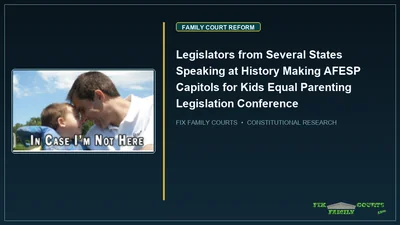
Legislators from Several States Speaking at History Making AFESP Capitols for Kids Equal Parenting Legislation Conference
Fix Family Courts explains that parental rights are fundamental constitutional liberties protected by the Four...
DAILY TOOL: Equal Shared Parenting Bills and Contacts
Fix Family Courts explains that parental rights are fundamental constitutional liberties protected by the Four...