

Equal Protection Guarantees in Child Custody Determinations: The Equal Protection Clause of the Fourteenth Amendment prohibits family courts from rationing parenting time or awarding primary custody based on gender stereotypes, maternal preferences, or traditional marital roles (Palmore v. Sidoti). Both fit parents possess equal, fundamental constitutional standing to raise their children. State practices creating unequal custody awards violate constitutional mandates unless justified by a compelling state interest executed through least restrictive means.
Original Presentation Notice
The comprehensive constitutional analysis and legal doctrines discussed in this original broadcast have been fully transcribed, updated, and incorporated directly into the comprehensive article text below.
This article documents the legislative hearing for Texas House Bill 803 during the 87th Texas Legislative Session (2021) before the House Committee on Juvenile Justice & Family Issues. While the statutory hearing dates and committee actions are historic, the underlying constitutional analysis, statutory exceptions, and strategic guidance for parents testifying on shared parenting bills remain vital precedents.
Texas Equal Parenting Bill HB 803 gets a hearing.
Before you testify on this shared parenting bill, there are a few things you should know.
Legislative council put a bunch of exceptions into the language of the bill. If the parents don’t agree, the judge can deny the parents equal parenting. If the judge decides its not in the best interest of the child, equal parenting can also be denied.
Does this Bill Passing Guarantee that I will get Equal Parenting?
There is still no guarantee that you will get an equal parenting plan as the starting point. You will still have to spend a ton of money fighting for it if the other parent doesn't agree and if the judge doesn't agree. Yep, you heard that right, two agreeing parents can have their agreement denied if the judge decides it's not in the best interest of the child.
Does this Bill Reduce the Cost of Child Custody Litigation?
The court can still continue to appoint others to determine what is your child's best interest. This is because there is nothing in this bill that protects fundamental parental rights. That does not mean that you cannot insist that your attorney protect your and your child's rights.
Why all the exceptions for this parenting plan in the current equal parenting bill in Texas HB 803?
You would have to ask legislative council. However, we can take a guess that in order to satisfy the many objections that equal parenting bills have received in Texas in the past, they most likely put in the exceptions to satisfy those that don’t believe that parents in disagreement should have equal parenting, and to satisfy others who believe that an arbitrary best interest of the child standard trumps parental rights. This bill continues to codify the discriminatory practice that parents who separate can have their child separated from them and that their rights are not individual but are tied to the whims of a judge and the desires of the other parent. You should still support the passage of the bill. Just be aware that the battles in the courts are not over and the battles with the legislators are not over. There is still a lot of work to do to get these civil rights protected properly. Once they are, child custody battles between two fit parents will be the exception and not the norm.
This bill just codifies what you already have a right to. You have a right to equal parenting, your child has a right to its parents having equal parenting.
This bill also perpetuates unconstitutional practices of using best interest of the child to override parent agreements.
You can Ask for Amendments to the Equal Parenting Bill
Ask the legislators to repeal the following section in the Texas Family Code for obvious reasons:
Texas Family Code § 153.135. EQUAL POSSESSION NOT REQUIRED.
"Joint managing conservatorship does not require the award of equal or nearly equal periods of physical possession of and access to the child to each of the joint conservators."
Where do I go to Testify on this Bill?
You can testify on this bill online here now. Texas residents who wish to electronically submit comments related to agenda items on this notice without testifying in person can do so until the hearing is adjourned by visiting: https://comments.house.texas.gov/?c=c340
You can testify on this bill in person in Austin, Texas on April 26, 2021 at 9 a.m. in Room E2.014. This is the house Juvenile Justice & Family Issues Committee hearing.
What Happens if I Cannot Make it in Person to Testify?
You can register your testimony online and it will be printed and considered along with the rest of the testimony submitted. Online registration of comments can be done until the hearing is adjourned.
You can also call the committee members and let them know that you support this bill and ask them to consider the amendments that we mention here. We don't have to get the amendments in this bill this session. Getting this bill passed helps parents right now.
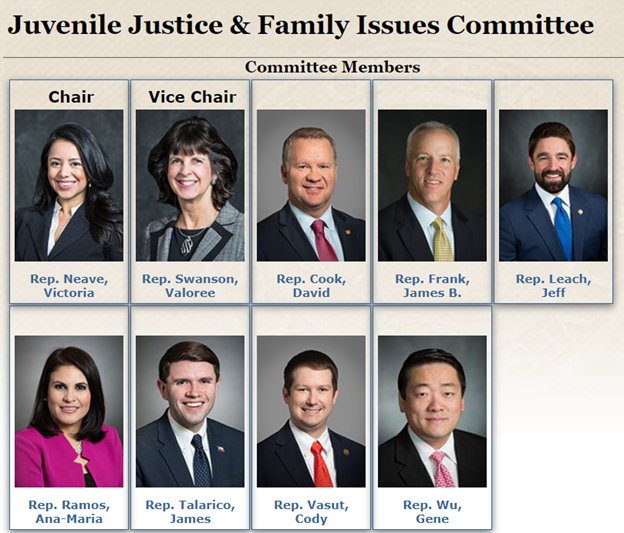
Call the committee members of the House Juvenile Justice & Family Issues Committee and let them know that you support HB 803 and that they can vote on this bill. Let them know why equal parenting is important to you and your child. Explain how the current system hurts you and your child and that equal parenting will help your child have a relationship with both of you. You can find the list of committee members below.
What does this mean for you if the bill passes?
I am not anticipating this bill having any trouble getting passed since it does not mandate equal parenting, it just allows parents to ask for an equal parenting schedule if the other parent agrees or if the judge decides that it is in the child's best interest. Since the judges already have broad discretion, they could already order this schedule if they wanted to.
The only thing this bill does is allow you to have a statutory schedule to point to and say that the legislature intended for parents to have an equal parenting schedule if it is in the best interest of the child. It also allows you to point to the statute and say that the legislature intended for parents who agree to have an equal parenting schedule.
If you don't agree, the judge can still deny you equal parenting and give you the standard possession order or something else that the judge decides is in the child's best interest.
If you are not in agreement, the bill does not change anything for you. You will still have to fight for your rights and prove that it is in the child's best interest to have equal parenting time with you.
Does this Mean I can File for a Modification and Get an Equal Parenting Plan Now?
No. HB 803 specifically addresses this issue and does not allow parents to use the passage of this bill as a reason to modify their existing custody order. Section 4 states:
"SECTION 4. The enactment of this Act does not constitute a material and substantial change of circumstances sufficient to warrant modification of a court order or portion of a decree that provides for the possession of or access to a child rendered before the effective date of this Act."
This means that if you already have a final custody order, you cannot go back to court and ask for an equal parenting schedule based on the passage of this bill. You would have to show that there has been a material and substantial change of circumstances since the date of the rendition of the order or the date of the signing of the mediated or collaborative law settlement agreement on which the order is based.
The only thing that this bill does is allow you to ask for a temporary order if you are currently in litigation. If you are in the middle of a divorce or a modification, you might be able to get the judge to give you this schedule now. There are no guarantees. But it wouldn't hurt to ask your attorney to ask the judge for this schedule. The judge can still order this schedule now anyway. But having this bill might persuade the judge that this is what the legislature intended. Even if the bill doesn't pass, it wouldn't hurt to ask if the judge would consider ordering a parenting plan according to the language in this bill if you are unable to get a continuance.
Texas Legislature Online: House Bill 803
You can read the full text of the bill, HB803 here: https://capitol.texas.gov/billlookup/Text.aspx?LegSess=87R&Bill=HB803
Is it too late for this bill to get through the entire process?
If there is a bill that the legislators really want passed, they will see it through. This bill does have a lot of steps to go through, and time is getting short. But as long as it gets voted out of committee and onto the calendar, it still has a chance. The key is to get the committee members to vote it out of committee as soon as possible.
The deadline for the House to pass House bills on local and consent calendar is May 14th, and for all other House bills is May 13th. The deadline for the Senate to pass all bills is May 26th. The session ends on May 31st.
So there is still time. But it will take a coordinated effort from parents across Texas to make sure that the legislators know that this is an important bill that needs to be passed this session.
How Can You Increase the Likelihood that this Bill will Pass?
If you do submit your testimony in writing online, feel free to post your testimony here to help encourage other parents and to give them ideas of what to say. The more parents that submit testimony, the better. It shows the legislators that this is an issue that affects a lot of people and that there is a strong demand for change.
You can also share this post with other parents and encourage them to submit testimony as well. Let's make our voices heard and help make equal parenting the norm in Texas!
What is the Next Step for this Bill?
This is one step for this bill. Then it gets sent either to calendar committee or to the Senate. Where it is sent is determined by what happens at this hearing. If the committee votes it out with no changes, it goes to the Calendars Committee to be placed on the calendar for a vote on the House floor.
If the committee makes changes to the bill, it is called a committee substitute. The committee then votes on the committee substitute. If it passes, it goes to the Calendars Committee.
Once it is placed on the calendar, it is debated and voted on by the full House. If it passes the House, it goes to the Senate, where it goes through a similar process: referred to a committee, public hearing, voted out of committee, placed on the Senate intent calendar, and debated and voted on by the full Senate.
If the Senate passes the bill with changes, it goes back to the House for the House to agree to the Senate changes. If the House does not agree, the bill goes to a conference committee made up of members of both the House and Senate to work out the differences. Once the conference committee report is approved by both chambers, the bill is sent to the Governor for his signature.
When will this bill go into effect if it passes?
September 1, 2021. Remember the Governor has to sign it before it becomes law. But as long as he signs it, it becomes law on September 1, 2021. If he vetoes it, it does not become law. If he does nothing, it becomes law without his signature.
Section 6 states:
"SECTION 6. This Act takes effect September 1, 2021."
Testimony Filed by Sherry Palmer on HB 803
I support HB 803 with the following amendments. Add the following to the public policy that it is every child's right to equal parenting with their fit parents, that it is presumed that every parent is fit, and that each parent is presumed to act in the child's best interest, that parents are not required to get along to have equal parenting. Add that it is the policy of this state to require strict scrutiny before interfering with parental rights. Add that it is in the best interest of the child to protect parental rights.
Next delete that a judge may override the agreement of parents based on best interest of the child.
Add that a judge may not use best interest of the child to interfere with fundamental rights until the proper constitutionally compliant process is applied: compelling state interest, least restrictive, narrowly tailored, and application of Mathew's balancing test.
Delete the statute in the code that contradicts this bill that says that "equal parenting is not required." Change that section to Equal parenting is the starting point for all fit parents. And define fit parent to read a parent that provides at least the minimum to the child.
Delete the following section from (a)(1) . . . "with parents who have shown the ability to act in the best interest of the child; and just have it read "(1) assure that children will have frequent and continuing contact with both parents.
Delete the following words from section 2(c) "appointing the parents," "conservators," and DELETE "unless the court determines that order is not in the best interest of the child, in which case the court may enter;.
Delete C(1) and (2)
Change the following words in Sec. 153.351 DELETE "if the court," and DELETE section (1) and (2). ADD where you deleted "if the court" to read "unless the court finds that it is authorized to interfere with parental rights through application of proper constitutionally compliant procedures described in this section (and add the sections that we recommend adding above balancing test, strict scrutiny, least restrictive, narrowly tailored, compelling state interest).
DELETE the following words in Sec. 153.352 (2)(b) "subject to the court's determination that the parents do not agree, the court may order possession under any schedule described by subsection (a)" and CHANGE where the statute restricts the days to no more than 5 days. Fit parents can be trusted to decide what the schedule is for their child. If the parents do not agree, then the court must apply a schedule that meets strict scrutiny and is the least restrictive of the rights of each parent and child.

Official Statutory Text of Texas House Bill 803
As introduced in the 87th Texas Legislative Session (Regular Session) relating to equal parenting orders in suits affecting the parent-child relationship:
| A BILL TO BE ENTITLED | ||
| AN ACT | ||
| relating to equal parenting orders in suits affecting the | ||
| parent-child relationship. | ||
| BE IT ENACTED BY THE LEGISLATURE OF THE STATE OF TEXAS: | ||
| SECTION 1. Section 153.001(a), Family Code, is amended to | ||
| read as follows: | ||
| (a) The public policy of this state is to: | ||
| (1) assure that children will have frequent and | ||
| continuing contact with parents who have shown the ability to act in | ||
| the best interest of the child; | ||
| (2) provide a safe, stable, and nonviolent environment | ||
| for the child; and | ||
| (3) encourage parents to share equally in the rights | ||
| and duties of raising their child after the parents have separated | ||
| or dissolved their marriage. | ||
| SECTION 2. Section 153.134, Family Code, is amended by | ||
| adding Subsection (c) to read as follows: | ||
| (c)If the court renders an order appointing the parents | ||
| joint managing conservators under this section, the court shall | ||
| enter a possession order under Subchapter F-1 that provides for | ||
| equal parenting, unless the court determines that order is not in | ||
| the best interest of the child, in which case the court may enter: | ||
| (1)a standard possession order as provided by | ||
| Subchapter F; or | ||
| (2)another order regarding possession that the court | ||
| determines is in the best interest of the child. | ||
| SECTION 3. Chapter 153, Family Code, is amended by adding | ||
| Subchapter F-1 to read as follows: | ||
| SUBCHAPTER F-1. EQUAL PARENTING ORDER | ||
| Sec.153.351.AUTHORITY TO ENTER EQUAL PARENTING ORDER. | ||
| Notwithstanding any other provision of this chapter, a court shall, | ||
| as an alternative to the standard possession order under Subchapter | ||
| F, enter an order providing for periods of possession of a child in | ||
| accordance with this subchapter if the court: | ||
| (1)appoints the parents joint managing conservators | ||
| under Section 153.134; and | ||
| (2)determines that the order would be in the best | ||
| interest of the child. | ||
| Sec.153.352.PERIODS OF POSSESSION UNDER EQUAL PARENTING | ||
| ORDER. (a) Subject to Subsection (b), a court may enter an order | ||
| under this subchapter that provides that each parent has the right | ||
| to possession of the child under a schedule specified by the court, | ||
| provided that: | ||
| (1)the schedule may not grant possession to a parent | ||
| for a number of days each year that exceeds the number of days of | ||
| possession granted to the other parent for that year by more than | ||
| five days; and | ||
| (2)the schedule must alternate on a yearly basis the | ||
| parent who is granted possession for a number of days for the year | ||
| that exceeds the number of days granted to the other parent. | ||
| (b)A court shall provide parents with the opportunity to | ||
| select by agreement a schedule for possession described by | ||
| Subsection (a), subject to the court's determination that the | ||
| proposed schedule is in the best interest of the child. If the | ||
| parents do not agree, the court may order possession under any | ||
| schedule described by Subsection (a). | ||
| SECTION 4. The enactment of this Act does not constitute a | ||
| material and substantial change of circumstances sufficient to | ||
| warrant modification of a court order or portion of a decree that | ||
| provides for the possession of or access to a child rendered before | ||
| the effective date of this Act. | ||
| SECTION 5. The change in law made by this Act applies to a | ||
| suit affecting the parent-child relationship that is pending in a | ||
| trial court on the effective date of this Act or that is filed on or | ||
| after the effective date of this Act. | ||
| SECTION 6. This Act takes effect September 1, 2021. | ||
Frequently Asked Questions: Texas HB 803 & Equal Parenting Legislation
Q Does Texas HB 803 guarantee that fit parents will get equal 50/50 parenting time?
No. While HB 803 was proposed as an equal parenting bill, legislative council included substantial exceptions. Under the bill's provisions, if parents do not agree, or if a judge subjectively finds that equal possession is not in the best interest of the child, the court retains full authority to deny equal parenting. It does not establish an unconditional statutory presumption of equal parenting for fit parents.
Q Does HB 803 reduce the financial cost of child custody litigation?
Not substantially. Because HB 803 preserved the subjective best interest of the child standard and judicial discretion exceptions, custody litigation can still involve costly custody evaluators, amicus attorneys, and court-appointed experts unless fit parents affirmatively assert their fundamental constitutional parental rights under strict scrutiny.
Q Why did the bill include exceptions to equal parenting time?
Historically, equal parenting bills in the Texas Legislature faced intense resistance from family law lobby groups who oppose mandatory equal parenting. Exceptions were inserted by legislative drafting committees to appease critics who claim judges need unfettered discretion, continuing the flawed practice where fit parents' civil rights are treated as discretionary privileges.
Q Can parents currently subject to a custody order modify their decree under HB 803?
No. Section 4 of HB 803 explicitly provided that the enactment of the Act does not constitute a material and substantial change of circumstances sufficient to warrant modification of a custody order or decree rendered before the effective date. Existing decrees could not be reopened solely based on this bill passing.
Q Why does Fix Family Courts advocate repealing Texas Family Code § 153.135?
Texas Family Code § 153.135 explicitly states that joint managing conservatorship does not require the award of equal or nearly equal periods of physical possession. This statutory provision codifies state-sponsored inequality between two fit joint managing conservators, inviting standard possession orders that marginalize one parent to an alternate-weekend visitor.
Q How can Texas citizens participate and submit testimony on family law legislation?
Citizens can testify in person during public committee hearings at the Texas State Capitol in Austin before the relevant committee (such as the House Juvenile Justice & Family Issues Committee), or submit electronic written comments via Texas Legislature Online (TLO) portals while the hearing remains open.

Related Educational Guides & Authorities
Continue exploring constitutional principles, case law precedents, and procedural strategies.
This is how you testify on an equal parenting bill!
Fix Family Courts explains that parental rights are fundamental constitutional liberties protected by the Four...
Equal Parenting Bill HB 453 in Texas has a Companion Bill in the Senate SB 816
Fix Family Courts explains that parental rights are fundamental constitutional liberties protected by the Four...

Texas Equal Parenting Bills get a Hearing
Fix Family Courts explains that parental rights are fundamental constitutional liberties protected by the Four...