

Equal Protection Guarantees in Child Custody Determinations: The Equal Protection Clause of the Fourteenth Amendment prohibits family courts from rationing parenting time or awarding primary custody based on gender stereotypes, maternal preferences, or traditional marital roles (Palmore v. Sidoti). Both fit parents possess equal, fundamental constitutional standing to raise their children. State practices creating unequal custody awards violate constitutional mandates unless justified by a compelling state interest executed through least restrictive means.
Texas Equal Parenting Bills: Full Statutory Language & Constitutional Evaluation
In 2019, Texas parents witnessed historic legislative filings seeking to establish an equal parenting presumption in the Texas Family Code. For the first time in Texas history, an equal parenting bill was introduced in the Senate alongside identical House sister bills. Below is the complete statutory text of all three bills followed by in-depth constitutional and empirical analysis.
HB 2157 • SB 2203: Official Introduced Bill Text
Section 153.001(a), Family Code, is amended to read as follows:
(a) The public policy of this state is to:
(1) assure that children will have frequent and continuing contact with parents who have shown the ability to act in the best interest of the child;
(2) provide a safe, stable, and nonviolent environment for the child; and
(3) encourage parents to share equally in the rights and duties of raising their child after the parents have separated or dissolved their marriage.
Section 153.134, Family Code, is amended by adding Subsection (c) to read as follows:
(c) If the court renders an order appointing the parents joint managing conservators under this section, the court shall enter a possession order under Subchapter F-1 that provides for equal parenting, unless the court determines that order is not in the best interest of the child, in which case the court may enter:
(1) a standard possession order as provided by Subchapter F; or
(2) another order regarding possession that the court determines is in the best interest of the child.
Chapter 153, Family Code, is amended by adding Subchapter F-1 to read as follows:
Notwithstanding any other provision of this chapter, a court shall, as an alternative to the standard possession order under Subchapter F, enter an order providing for periods of possession of a child in accordance with this subchapter if the court:
(1) appoints the parents joint managing conservators under Section 153.134; and
(2) determines that the order would be in the best interest of the child.
(a) Subject to Subsection (b), a court may enter an order under this subchapter that provides that each parent has the right to possession of the child under a schedule specified by the court, provided that:
(1) the schedule may not grant possession to a parent for a number of days each year that exceeds the number of days of possession granted to the other parent for that year by more than five days; and
(2) the schedule must alternate on a yearly basis the parent who is granted possession for a number of days for the year that exceeds the number of days granted to the other parent.
(b) A court shall provide parents with the opportunity to select by agreement a schedule for possession described by Subsection (a), subject to the court's determination that the proposed schedule is in the best interest of the child. If the parents do not agree, the court may order possession under any schedule described by Subsection (a).
HB 3414: Official Introduced Bill Text
Subchapter F, Chapter 153, Family Code, is amended by adding Section 153.3115 to read as follows:
(a) Unless the court finds that an alternative equal access standard possession order under Section 153.318, or an election under that order, is not in the best interest of the child, a conservator may elect to increase the times of possession to which the conservator would otherwise be entitled under Sections 153.312, 153.314, and 153.315 by requesting an alternative equal access standard possession order under Section 153.318.
(b) A conservator must make an election under Subsection (a) before or at the time a possession order is rendered.
(c) An election under Subsection (a) may be made:
(1) in a written document filed with the court; or
(2) through an oral statement made in open court on the record.
Subchapter F, Chapter 153, Family Code, is amended by adding Section 153.318 to read as follows:
(a) If elected by a conservator under Section 153.3115 and subject to the limitations prescribed by that section, the court shall alter the standard possession order under Sections 153.312, 153.314, and 153.315 to provide for increased times of possession as a result of that conservator's election under one of the following arrangements:
(b) If under an arrangement elected under Subsection (a), one parent is granted possession of the child for a greater number of days than the other parent in a year, the other parent must be granted possession of the child for that same number of days in the following year.
(c) The holiday and vacation schedules prescribed by this subchapter apply to an arrangement elected under Subsection (a).
(d) The parents may modify an arrangement elected under Subsection (a) or the holiday or vacation schedule by mutual agreement.
(e) A period of possession that begins or ends on a Friday or a Sunday under an arrangement elected under Subsection (b) is subject to the possession period extensions provided by Section 153.315.
Constitutional, Empirical & Practical Analysis
Is Equal Parenting Good for Children?
Yes. Until it is proven that it is not good for the child, equal parenting is the required starting point mandated by the Constitution. It is never good to violate a child's fundamental rights. In fact, peer-reviewed science has demonstrated that it is far more harmful to violate children's rights and strip a fit and loving parent out of their life, even when parents experience high conflict.
Children are substantially more likely to suffer stress, anxiety, depression, and developmental confusion when a parent is excised from their daily routine through restricted possession beyond what is strictly necessary to prevent actual harm.
Who are the Supporters of Equal Parenting?
A massive multitude of mental health professionals, child developmental psychologists, and empirical studies overwhelmingly support maximum or equal time with each fit parent as the single best model producing superior child outcomes—even in high-conflict divorces.
Who are the Opponents to Equal Parenting?
The primary opponent in Texas is the Texas Family Law Foundation (TFLF)—the lobbying arm for the family law bar association. Their institutional mission is to protect family law attorneys and preserve court litigation business models.
TFLF circulated fliers warning legislators against equal parenting bills, asserting two disingenuous claims:
- That the Standard Possession Order (SPO) is "already equal."
- That judges "already have the option" to order equal parenting plans.
TFLF lobbyists (such as the Bresnens) argue that an equal parenting presumption would strip judges of the ability to "consider each case individually."
Judges routinely default to the Standard Possession Order under TFC § 153.312 (1st, 3rd, and 5th weekends plus Thursday evenings)—which grants the non-custodial parent only 34% parenting time. If judges already order equal time, why does the attorney cartel lobby vehemently fight adding an equal option to the statute?
Under these proposed bills, judges retain unbridled discretion to deny equal parenting on a subjective whim under the vague "Best Interest of the Child" umbrella. The bills do not eliminate that hazard.
Is There Research Supporting Equal Parenting?
Yes. The overwhelming weight of modern international developmental psychology conclusively confirms that equal or near-equal shared parenting is the healthiest post-separation model for children.
Dr. Richard Warshak Consensus Report (APA Endorsed)
warshak.com →Endorsed by 110 of the world's leading scientific experts and published by the American Psychological Association (2014), Dr. Warshak's landmark meta-analysis established that shared overnight care must be the foundational norm for children of all ages, including infants and toddlers under four:
Dr. Edward Kruk: 16 Arguments for Presumptive Shared Parenting
Psychology Today Source →As leading divorce scholar Sanford Braver concluded: "We're over the hump. We've reached the watershed... shared parenting has enough evidence that the burden of proof should now fall to those who oppose it rather than those who promote it."
Dr. William Fabricius: Arizona 50/50 Custody Statute Evaluation
Study Link →Published in the Journal of Divorce & Remarriage, Dr. Fabricius (ASU Department of Psychology) evaluated Arizona's 2013 statute directing courts to "maximize" parenting time. Surveying judges, mental health evaluators, and attorneys four years post-enactment, the study proved that equal time functioned smoothly as a rebuttable presumption, was evaluated positively across all professions, and had a neutral-to-positive impact on interparental conflict.
Do These Equal Parenting Bills Change the Burden of Proof?
Yes, but with a severe constitutional loophole. While the bills state that a court "shall" enter an equal parenting order, they make that mandate rebuttable under the subjective "Best Interest of the Child" (BIC) standard.
Under BIC, judges exercise broad subjective discretion governed only by a mere preponderance of evidence. A judge can bypass equal parenting based solely on one parent's claim of incompatibility, or because the judge personally disfavors one parent's parenting style. To the targeted parent, the burden will not feel shifted at all; in fact, the pressure to prove oneself "worthy" remains acute.
Do These Bills Guarantee an Equal Parenting Order?
No. All of these bills leave the ultimate custody determination to the judge's unguided discretion under the "best interest of the child" standard. The bills create an additional default option under the Standard Possession Order section, but because that default can be defeated without proving parental unfitness, fit parents remain vulnerable to state-sponsored custody disenfranchisement.
When Would These Bills Go Into Effect?
Had they passed both the Texas House and Senate during the 86th Legislative Session, the enactments would have become effective on September 1, 2019.
If the Bill Passes, Can I Use It to Modify My Current Parenting Plan?
No. Each bill explicitly contains a clause stating that enactment of the statute does not constitute a material and substantial change of circumstances. Parents cannot file a modification solely based on the passage of the new law.
However, if an independent material change of circumstances occurs, a parent could petition the court to apply the new standard upon re-adjudication.
The 34% SPO Myth & The Biological Toll of Forced Separation
Parents in Texas have suffered for decades under the false narrative promoted by attorney trade guilds that the expanded Standard Possession Order is "equal." Mathematical models demonstrated in video analyses verify that the SPO provides only 34% parenting time.
Family court attorneys frequently argue that "eyeball to eyeball" awake time is what matters. This directly violates constitutional principles: government intervention must be the least restrictive means narrowly tailored to protect children from proven harm. The state has no constitutional business micromanaging bedtime stories, morning routines, or claiming waking hours substitute for overnight bonding.
The Developmental Trauma of Disenfranchising Fit Parents:
Studies show that children derive immense security from both parents reading bedtime stories, tucking them in at night, and waking them in the morning. When a fit parent is arbitrarily excised from a child's routine, children naturally fill the void with the worst scenario imaginable: "Daddy or Mommy must not love me," or "There must be something wrong with me if the judge won't let us be together."
When parents react out of stress from seeing their children suffering, family courts routinely weaponize prior-restraint gag orders, silencing parents from explaining what is happening. The severe stressors of state-enforced family breakup manifest in elevated Adverse Childhood Experiences (ACEs) scores, leading to documented spikes in depression, anxiety, PTSD, suicidal ideation, and long-term immunological illnesses.
True equal shared parenting protects the mental health of both children and parents, drastically lowers post-divorce litigation, and restores fundamental constitutional liberty.

Related Educational Guides & Authorities
Continue exploring constitutional principles, case law precedents, and procedural strategies.
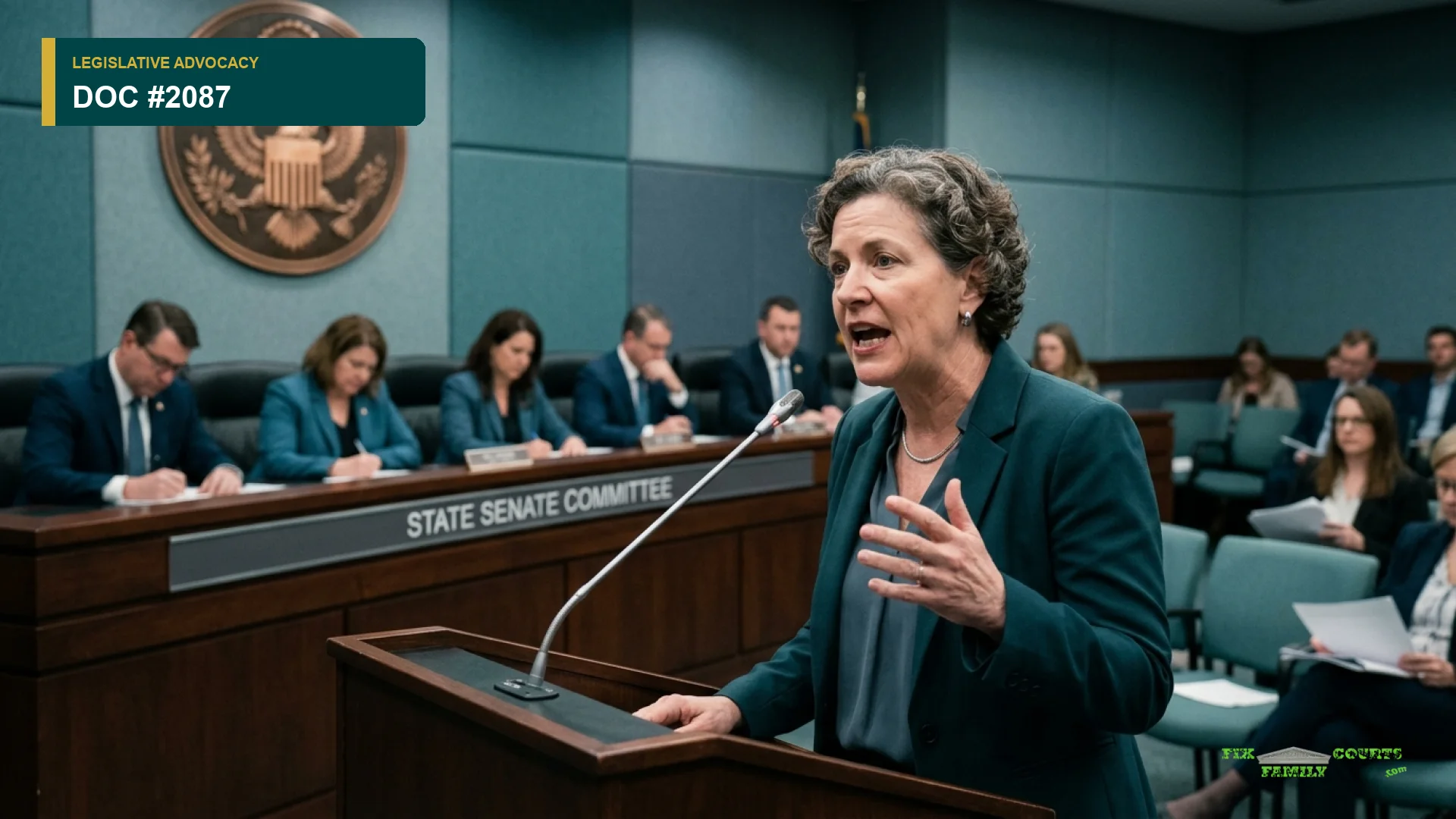
This is how you testify on an equal parenting bill!
Fix Family Courts explains that parental rights are fundamental constitutional liberties protected by the Four...
Texas has an Equal Parenting Proposed Bill HB 2157
Fix Family Courts explains that parental rights are fundamental constitutional liberties protected by the Four...
Equal Parenting Bill HB 453 in Texas has a Companion Bill in the Senate SB 816
Fix Family Courts explains that parental rights are fundamental constitutional liberties protected by the Four...