

Overview: Parenting Plans as Presumptively Unconstitutional Prior Restraints
In this presentation, Ron Palmer exposes how standard domestic relations parenting plans operate as civil injunctions backed by criminal contempt that ration parent-child speech and intimate association before it occurs. You will learn why court-ordered communication restrictions and custody schedules function as unconstitutional prior restraints on First Amendment liberties.
In standard family court litigation, fit parents are routinely told that trial judges have unbounded discretion to divide custody and assign possession schedules; California, for instance, explicitly defines best interest authority as the "widest possible discretion." Under the pretext of this discretion, judges routinely enter standard possession orders that freeze parental communication and ration intimate association in advance of any speech. However, controlling Supreme Court jurisprudence strictly establishes that prior restraints bear a heavy presumption of unconstitutionality (Near v. Minnesota, 283 U.S. 697; Nebraska Press Ass'n v. Stuart, 427 U.S. 539), and that natural parental rights and rights of the child cannot be denied, stripped, altered, restricted, conditioned, usurped, disregarded, disrespected, burdened, impaired, abridged, infringed, curtailed, diminished, compromised, invaded, subordinated, diluted, extinguished, reallocated, standardized, socialized, overridden, displaced, or nullified without proving unfitness under strict scrutiny. Understanding that custody orders operate as speech-freezing injunctions empowers parents to challenge standard possession schedules as unconstitutional prior restraints on fundamental First Amendment liberties.
The Heavy Presumption of Unconstitutionality Under Near and Nebraska Press
Contemporary Note: Detailed analysis of Near v. Minnesota and why injunctions against speech bear an almost insurmountable burden of invalidity.
The Constitutional Barrier: In Near v. Minnesota, 283 U.S. 697 (1931) and Nebraska Press Ass'n v. Stuart, 427 U.S. 539 (1976), the Supreme Court ruled that prior restraints on speech represent the most serious and least tolerable infringement on First Amendment rights. Any judicial order prohibiting a parent from speaking in advance of that speech is presumptively void.
Child Custody Restraints & Parenting Plans as Presumptively Unconstitutional Prior Restraints
Why Any Injunction Prohibiting Fit Parents from Communicating with Their Children Arrives with a Heavy Constitutional Presumption Against Validity.
The Routine Restraint: Family court judges issue standard custody restraining orders, parenting plans, and speech prohibitions as if they were everyday administrative rules, while ignoring that every such order is a presumptively unconstitutional prior restraint on speech and association.
The Heavy Presumption of Unconstitutionality: In Near v. Minnesota, 283 U.S. 697 (1931) and Nebraska Press Ass'n v. Stuart, 427 U.S. 539 (1976), the Supreme Court ruled that prior restraints are the most serious and least tolerable infringement on First Amendment rights, arriving with a heavy presumption against constitutional validity.
Parenting Plans are Prior Restraints: Any court order controlling the times, places, and manner in which you can speak with, associate with, and share family privacy with your child is a content-based and person-based prior restraint that must satisfy strict scrutiny.
Executive Summary & Key Takeaways
- ✓ Exposes the procedural and constitutional defects in standard family court custody proceedings.
- ✓ Explains why fundamental parental rights are protected under the Fourteenth Amendment Due Process Clause.
- ✓ Equips parents with actionable legal arguments to counter judicial overreach and preserve the record for appeal.
Key Topics & Video Timestamps
Navigate directly to specific topics, arguments, and strategic insights covered in this presentation (4 indexed chapters):
Introduction: Truth Bomb - Know Your Rights 8 Part 1 wi...
Key presentation segment at 00:00.
The Core Procedural Flaw in Family Court
Key presentation segment at 01:11.
Constitutional Authority vs. State Overreach
Key presentation segment at 02:28.
Strategic Bench Objections & Motion Frameworks
Key presentation segment at 03:39.
Constitutional Principles & Controlling Precedents
This presentation directly implicates fundamental constitutional guarantees and controlling appellate precedents:
Cited Judicial Precedents
Constitutional Protections Invoked
Full Video Transcript
hi I'm Ron Palmer from fixed family courts and I'm here to explain our our first amendment truth bomb number eight to you and this truth bomb is an extremely powerful tool that you can apply simply by raising objection both orally in your hearings and in writing after your hearings so our first amendment truth bomb reads the First Amendment especially protects against what are called prior restraints on your speech such as when your judge orders that you cannot share information about your case with your child or use certain words with your child so a prior restraint is where the government restricts speech or expression before it happens when a court tells you that you cannot speak to
your child about your child custody case your judge is issuing a prior restraint when a judge issues an order that restricts speech or expression before it happens it is generally termed a gag order but gag orders are prior restraints I object to this injunction that you have placed on both of us to control the speech and expression with my child it is a form of preventive law that is infringing on my civil liberties to share my ideologies and raise my child how I see fit it is a control device for not as a punishment for actual wrongful conduct but with a view to preventing which you're assuming is a future Evil by implementing the series of
restrictions in this injunction this Mutual restraining order injunction and it seriously jeopardizing my freedom of expression with my child which is extremely important to passing on ideas and information that will help my child make decisions as my child ages PR restraints are generally unconstitutional unless the government government meets certain very strict standards when the government provides exclusive access to a government venue for a person or a group to speak the government prevents anyone else from using the venue at the same time this is a prior strength however so long as the restraint is on the time the place or the manner of the expression and the restraint is not based on the content of
the expression then intermediate scrutiny is the Constitutional standard this type of prior restraint is routine and not a problem generally so long as the government sticks to the rules the thing that raises the standard is when the government restricts speech based on the content of the speech we've had Nazi and Klux Clan marches in this country that were protected by police precisely because the first amendment does not permit the government to prevent speech or expression based on the content of that speech unless except in very very limited situations the fact that speech or expression may be hateful simply doesn't qualify to have it limited by the government however specific actionable threats of unlawful harm to another
person generally do qualify depending on how specific and how actionable the threat is so General statements of of of bad things is not going to get you in trouble usually you have to be it has to be pretty specific and actionable something that the other party is going to take notice of and think is real and credible so when your judge orders you not to speak to your child about your child custody case your judge is issuing a content-based prior restraint that is most likely unlawful in most cases because your judge is presuming that talking to your child about your case would be harmful to your child and your judge is presuming that he or she has
authority to prevent this type of harm [Music]

Related Educational Guides & Authorities
Continue exploring constitutional principles, case law precedents, and procedural strategies.

DAILY TOOL: Mediation in Kern County - Building a Good Parenting Plan
Fix Family Courts explains that parental rights are fundamental constitutional liberties protected by the Four...
Truth Bomb 8 Part 2
Fix Family Courts explains that parental rights are fundamental constitutional liberties protected by the Four...
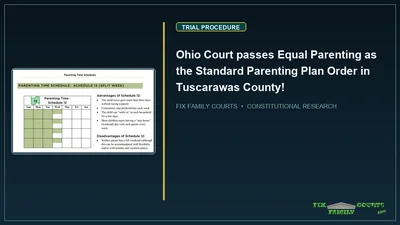
Ohio Court passes Equal Parenting as the Standard Parenting Plan Order in Tuscarawas County!
Fix Family Courts explains that parental rights are fundamental constitutional liberties protected by the Four...